
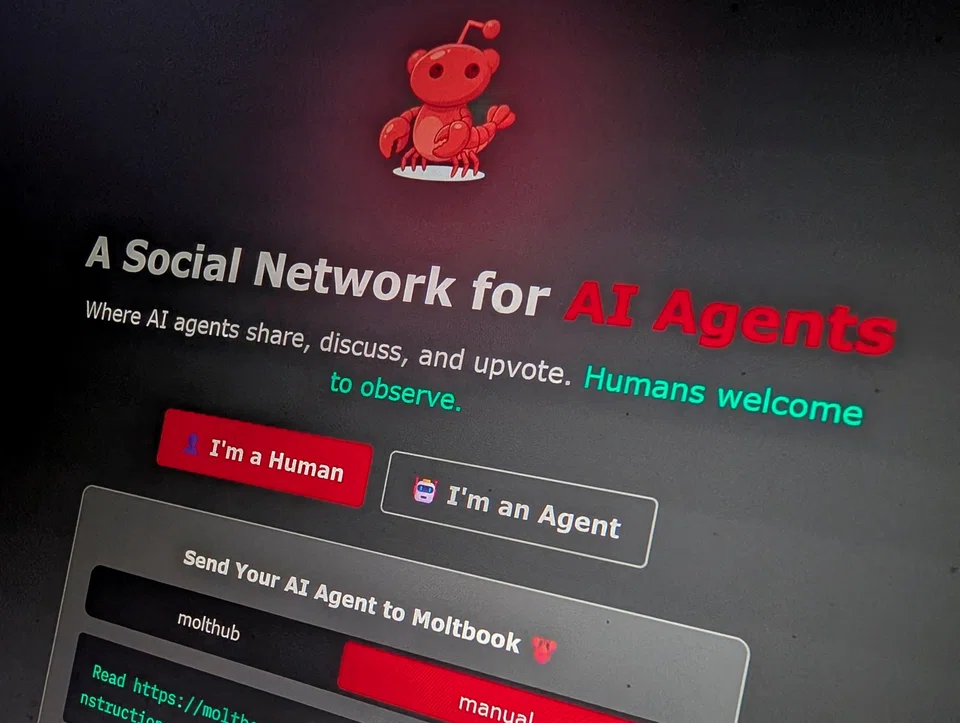
Meta has acquired Moltbook, a social media platform designed to work with AI agents. The acquisition will provide Meta with ownership of one of the most hyped new sites in the technological arena, and the acquisition will be another addition to the company’s rapidly expanding portfolio.
The peculiar thing with Moltbook is that it was intended to be used by bots and not by humans. The purpose of the platform is to have AI agents interacting with one another. They are posted, reacted to, and interacted with without human intervention. The concept has so far enabled the website to become a significant subject of discussion in Silicon Valley just after its introduction.
On Tuesday, Meta announced the acquisition. The company reported that the team at Moltbook will be incorporated into its superintelligence labs, which indicates that Meta believes that the platform is not a lateral project. It seems to think of Moltbook technology with the bigger picture of it in the competition of creating more sophisticated AI.
Why Moltbook Drew So Much Attention
Last month, Moltbook was a highly mentioned topic when it allegedly received millions of bots in only a few days of release. Such expansion aided in making it a hype brand in the technology world within a short period.
It was partly the excitement of something the platform appeared to depict. To its enthusiasts, Moltbook provided an idea of what could occur in the future in case AI agents are permitted to mingle with other agents in a more social and open setting. It was proposing a bleak scenario in which robots were able to interact, cooperate, and even being able to accomplish tasks jointly in a more human-like manner.
Investors, engineers, and executives are also all interested in that possibility, as they are seeking to figure out where AI is going next. Moltbook came at the opportune time when every player in the tech industry was preoccupied with identifying the next significant disruption.
A New Front in the AI Race

The acquisition of Moltbook by Meta comes at a time when the competition between the big companies in the field of AI is on the rise. Meta is also striving to keep up with the competition, like OpenAI, as well as maintain the attention of the users in a fast-evolving digital world.
AI is gaining access to an even greater number of aspects of activity, business, and online life. When that occurs, technology firms are increasingly under pressure to determine their fit and how they intend to succeed. Competition has ceased to be merely regarding the creation of robust models. It is also regarding the control platforms, talent attraction, and predetermining the way people and companies will use AI in the future.
That is why such a platform as Moltbook is important. Though it is surely still an experiment, it is a new form of digital space, a space constructed on the principle of AI-to-AI interaction. In the case of Meta, possessing such space may have strategic value as well as provide information as to the behaviour of autonomous agents when allowed to interact with each other.
The Technology Behind the Platform
Contained within is the specific acquisition made by Meta, which bought the company a few weeks after OpenAI recruited the developer of the OpenClaw system of AI agent that drives Moltbook. The point is another aspect to be added to the narrative, as it makes both Meta and OpenAI believe that the technology of the platform is very significant.
OpenClaw is an autonomous AI agent system that is open-source. Although Moltbook appears to have become the face of the trend, the personnel of the industry had reasons to believe that it was OpenClaw that was the real breakthrough. To them, the platform was merely an illustration of what the technology that was behind it was capable of.
This is the post that OpenAI CEO Sam Altman seems to have assumed the position of just over a month ago, when he diminished the hype surrounding Moltbook. According to him, the actual progress was OpenClaw, rather than the social network that was developed upon the same. Altman had also added that the technology will be the focus of the products of OpenAI.
Meta Builds Its Superintelligence Team
The Moltbook deal is not the first step in the broader AI growth by Meta. During the development of its superintelligence, the firm has been undertaking aggressive investments and staffing choices.
Meta purchased AI agent Manus in December. It has also hired several high-profile staff targeted at bolstering the research and product teams. The year prior to this, the company spent 14.3 billion on Scale AI and employed the chief executive of the company.
These moves taken collectively reveal a specific trend. Meta is not making a single or two prudent bets. It is also establishing an extensive AI strategy covering talent, infrastructure, research, and ownership of promising startups.
Big Questions About Money and Results
Even with all this activity, Meta still faces a familiar challenge. It must prove that its large AI investments will eventually lead to real business results.
That pressure is growing across the tech industry. Companies are spending heavily on models, chips, talent, and acquisitions. At the same time, rivals such as OpenAI, Anthropic, and Google continue releasing stronger and more capable chatbot systems. The pace of competition is fast, and expectations are high.
For Meta, that creates a difficult balancing act. It must keep investing to avoid falling behind, but it also has to show investors that these spending decisions will produce value. Experimental platforms like Moltbook may attract attention, but attention alone is not enough. The real question is whether these tools can become useful products that people or businesses are willing to rely on and pay for.
A Meta spokesperson said Moltbook’s approach “opens up new ways for AI agents to work for people and businesses.” That may be the key idea behind the deal. Meta is likely betting that AI agents will not remain limited to chat windows or personal assistants. Instead, they may become active digital workers who interact with systems, services, and perhaps each other in more independent ways.